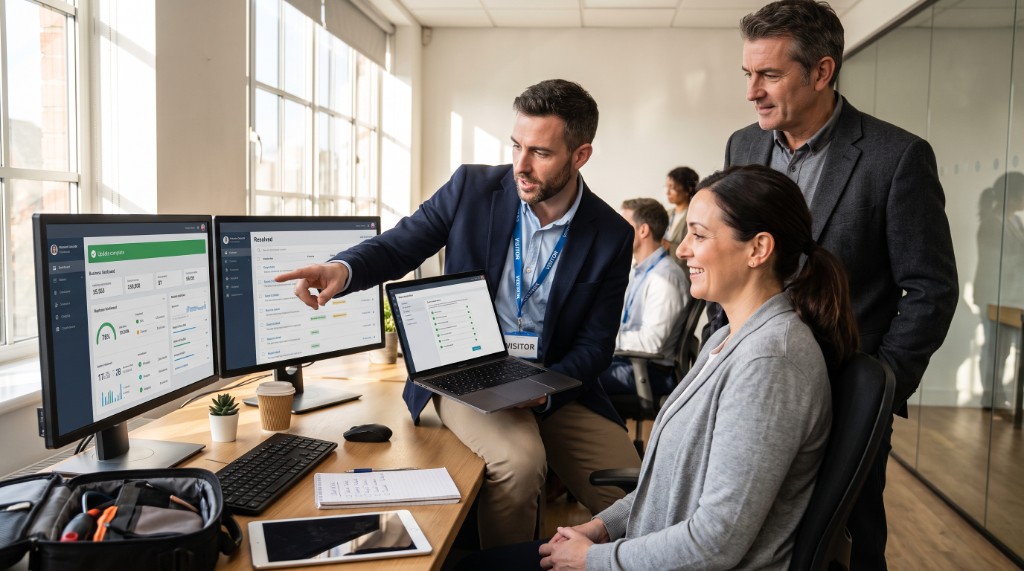

When it comes to tailored software development for enterprises, custom software delivers advantages that off-the-shelf platforms cannot match: solutions built around exact workflows, scalability that grows with operations, and seamless integration with existing systems. Inspirovate Creatives builds Mobile & Software Solutions engineered for automation, lower long-term licensing costs, and measurable operational efficiency, giving IT leaders infrastructure designed for sustained growth.
Key Takeaways
- Custom software aligns with your workflows and removes the inefficiencies of generic off-the-shelf tools.
- Scalable systems grow with the business without full replacements or costly migrations.
- Tailored solutions reduce operating costs by automating the processes specific to your enterprise.
- Purpose-built technology keeps you competitive as market and operational demands change.
Why Do Off-the-Shelf Systems Limit Enterprise Growth?
Generic platforms force enterprise teams into someone else's workflow instead of supporting their own. Off-the-shelf software lacks the customization required for unique operational demands. That gap creates friction across departments, reporting structures, and customer touchpoints. Enterprises absorb the cost through workarounds, manual data entry, and features nobody asked for.
Growth trajectories differ by industry, and technology built for a mass market cannot account for that variation. Tailored software development for enterprises starts from the opposite premise: adapt the system to the organization, not the other way around. An effective strategy accounts for the demands, trends, and customer expectations that define each sector. A logistics firm and a healthcare provider do not run on the same rules.
Does company size change the need for custom software?
Scale changes the stakes, not the principle. Whether the client is a local retailer or a global company, the need stays the same: a technology partner who understands the operating model, not only the industry label. Off-the-shelf tools rarely flex enough to serve both ends of that spectrum.
Common friction points enterprises report with generic systems include:
- Rigid workflows that force teams to change how they work, rather than the software adapting to them
- Limited integration with existing tools, which creates data silos
- Feature sets built for a broad market that miss industry-specific requirements
What Operational Gains Justify the Software Investment?
Operational efficiency justifies the investment first. Tailored software development for enterprises automates repetitive tasks that once consumed staff hours across departments, freeing teams for higher-value work. Manual processes slow decision-making and multiply errors. Automation removes both risks.
Beyond daily efficiency, enterprise leaders weigh long-term scalability. Custom platforms grow with the business model instead of forcing a costly system replacement later. That adaptability protects the initial investment and keeps the technology relevant over time.
Does working with one integrated partner reduce operational risk?
Consolidating development, design, and marketing with a single provider removes the friction of juggling disconnected vendors. Enterprises gain one accountable partner instead of managing multiple contracts, timelines, and communication gaps. This structure supports faster deployment and clearer ownership of outcomes.
Can a single technology partner support multi-region enterprise operations?
National reach matters for enterprises that operate across regions or business models. A partner that maintains a core operational base while serving clients across the United States can support distributed teams without losing consistency.
| Operational Gain | Business Impact |
|---|---|
| Task automation | Higher departmental efficiency |
| Unified service delivery | Reduced vendor management overhead |
| Regional support capacity | Consistent execution across markets |
| Scalable architecture | Long-term growth without a system overhaul |
Inspirovate Creatives structures engagements around these gains, aligning technology investment with measurable enterprise outcomes.
How Should Enterprises Plan the Software Transition?
Enterprises plan a successful software transition by treating custom development as a long-term partnership, not a one-time purchase. Tailored software development for enterprises covers ongoing design, build, and continuous improvement of applications built around one organization's workflows. Skipping this mindset leads companies back to rigid systems that stall growth within a few years.
Readiness varies by organization. Some teams are just starting to modernize outdated processes. Others are scaling quickly and need infrastructure that keeps pace. Either scenario calls for solutions built around specific operational pain points, rather than generic fixes borrowed from unrelated industries.
What should enterprise leaders check before selecting a development partner?
Operational presence and accountability matter as much as technical capability. Inspirovate Creatives, headquartered in Porter Ranch, California, is the kind of established, locatable partner enterprises should look for when vetting vendors.
When should IT leaders start the conversation with a development team?
Opening a direct conversation before committing budget prevents costly missteps later in the build. Enterprise leaders benefit from discussing goals, constraints, and timelines early, before a contract is signed.
Planning a transition well involves three steps:
- Assess current pain points and the growth trajectory.
- Confirm the partner's location and long-term accountability.
- Start a direct conversation before allocating budget.
This sequence keeps enterprise transitions grounded in real operational needs.
FAQ
Why do off-the-shelf systems limit enterprise growth?
Generic platforms force teams into someone else's workflow, creating friction across departments and reporting structures. Enterprises absorb the cost through workarounds, manual data entry, and features that do not match their operations.
Does company size change the need for custom software?
Whether the organization is a local retailer or a global company, it needs a technology partner who understands its operating model, not a generic tool labeled for the industry.
What operational gains justify the software investment?
Custom software automates repetitive tasks, freeing staff for higher-value work and reducing delays and errors in decision-making. It also scales with the business model, so the investment does not become obsolete.
Conclusion
Custom software development is a strategic investment that reshapes enterprise operations through solutions designed for specific business objectives. Aligning technology with organizational needs creates a competitive advantage grounded in efficiency, scalability, and measurable growth. The result is a digital infrastructure that evolves with the enterprise and continues to deliver value as the market grows more complex.